




Description
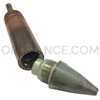
U.S. Navy 1.1-Inch/75 Caliber High-Explosive Round with Mark 1 Mod 28 Projectile
This U.S. Navy 1.1-inch/75 caliber high-explosive round combines an Antiaircraft Mark 1 Mod 28 projectile, a Mark 1 Navy case, and a Mark 19 Mod 2 primer. Offered inert for collection and display, it represents the ammunition used in the Navy’s quadruple 1.1-inch antiaircraft mounts during World War II. It is a useful example for collections covering American naval ammunition and shipboard air defense.
Mark 1 High-Explosive Antiaircraft Projectile
The Mark 1 AA service projectile combined an Explosive D bursting charge with an integral tracer at the base. The bursting charge broke the projectile into fragments to damage aircraft, while the tracer helped gun crews observe their fire. Navy ammunition tables list a loaded projectile weight of 0.917 pound. Historical ammunition testing used a muzzle velocity of approximately 2,700 feet per second in a new gun.
Impact Fuzes and Self-Destroying Developments
The 1.1-inch AA ammunition used sensitive nose fuzes intended to burst the projectile just after striking thin metal or aircraft fabric. Mark 12 Mods 2 and 3 were in use by 1939. The later Mark 34 fuze drew largely on the 40mm Mark 27 Mod 1 design and entered production in early 1943 to replace the Mark 12. The original Mark 1 projectile did not have a self-destroying feature.
Mark 1 Brass Case and Mark 19 Mod 2 Primer
The Mark 1 brass case formed part of the Navy’s fixed ammunition system, in which the projectile and charged case were loaded into the gun as one round. The case design appears in Bureau of Ordnance drawings dated August 1933, linking it to the gun’s prewar development. The Mark 19 Mod 2 percussion primer belongs to the primer series documented for this ammunition. Seated in the case head, its service role was to ignite the propelling charge when struck by the gun’s firing pin.
Development of the Navy’s 1.1-Inch Gun
The Bureau of Ordnance began the program in 1928 to provide an explosive-projectile weapon against dive and level bombers, supplementing the .50-caliber machine gun. The gun mechanism was designed by 1930, and initial firing trials followed in 1931. Improvements raised the cyclic rate to approximately 140 rounds per minute per gun before the design went to the Naval Gun Factory for production in 1934. A quadruple mount concentrated the fire of four guns to approach the volume delivered by a .50-caliber machine gun while firing much larger projectiles. The first mount was completed in April 1935.
Shipboard Service in World War II
The 1.1-inch gun served aboard American battleships, aircraft carriers, cruisers, and other naval vessels. USS North Carolina (BB-55) carried four quadruple mounts during the Battle of the Eastern Solomons on 24 August 1942, when her antiaircraft batteries defended the ship and carrier force against Japanese aircraft. USS Enterprise (CV-6) also carried 1.1-inch mounts during the early Pacific campaigns. Her wartime history records an additional mount fitted at the bow after Midway, followed by replacement of four 1.1-inch mounts with quadruple 40mm mounts during repairs completed in October 1942.
Replacement by the 40mm Bofors
Vibration, smoke interference, and operating difficulties led to changes in the 1.1-inch mounts and their controls. The Navy ultimately adopted the 40mm Bofors as its replacement as improved aircraft demanded heavier antiaircraft fire. Procurement of 1.1-inch equipment continued until the 40mm program was established, ending in December 1942. Existing mounts remained aboard destroyer escorts and auxiliary vessels into 1945, while others served at naval bases and training establishments.
Condition
All ordnance is inert. Please check the pictures for the general condition of the item.
Ideal For
This round supports displays and research tracing the Navy’s move from machine guns to heavier automatic antiaircraft weapons.
- U.S. Navy and World War II ammunition collections.
- Displays interpreting quadruple 1.1-inch naval gun mounts.
- Comparative studies of Mark 1 projectiles, Navy cases, and percussion primers.
- Museum exhibits covering early Pacific War shipboard air defense.
Approx length 12", Approx width 1.75", Approx height 1.75", Approx weight 1.7lbs.
Pictures are stock images of our inventory. Unless otherwise noted, you will not be receiving the exact item shown in the pictures. The pictures are representative of the item’s general condition. The item you receive might be slightly better, or worse, condition than was shown in the pictures.
Please visit our page about order lead times here: Order Lead Times.