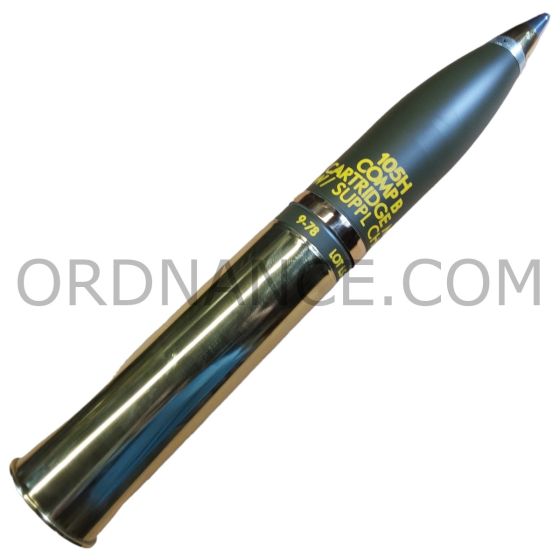
105mm M1 High Explosive Howitzer Round

SKU:
105mm high explosive Howitzer M1 round
105mm Weapon Systems:
105mm M2 / M3 / M4 / M49 / M101 / M102 / M103 / M119 / M137 Howitzer Ammunition (105x372mm-R)
Complete Rounds:
Restored
  • 105mm high explosive howitzer M1 round
  • 105mm high explosive howitzer M1 round
  • 105mm high explosive howitzer M1 round
  • 105mm high explosive howitzer M1 round
  • 105mm high explosive howitzer M1 round
  • 105mm high explosive howitzer M1 round
  • 105mm high explosive howitzer M1 round
  • 105mm high explosive howitzer M1 round
  • 105mm high explosive howitzer M1 round
  • 105mm high explosive howitzer M1 round
  • 105mm high explosive howitzer M1 round
$875.00

Sold Out

Frequently bought together:

Description

Inert U.S. 105mm M1 High-Explosive Howitzer Round

Item Overview

This inert restored U.S. 105mm M1 High-Explosive (HE) howitzer round is a complete, full-size artillery display with an empty fuze, empty projectile, and empty cartridge case. It is 100% inert and contains no energetic, explosive, incendiary, primer, or propelling material. The M1 HE round became a workhorse of American light field artillery during World War II and continued in service through later generations of towed, self-propelled, and aircraft-mounted 105mm weapons. This example is in beautiful near-mint condition and stands just under 31 inches tall, making it an impressive centerpiece for a military collection. It is safe for normal display and handling, although its 32.5-pound weight means you still should not drop it on your foot.

Identification and Features

The official military designation is Cartridge, 105mm: HE, M1. A service cartridge was semifixed ammunition, meaning the projectile and cartridge case were handled and loaded as one round, while the removable case allowed the crew to adjust the propelling-charge increments for the required range. The original M1 projectile used a hollow forged-steel body with a streamlined nose, boat-tailed base, welded base cover, and gilding-metal rotating band. Live projectiles were commonly filled with TNT or Composition B and could have shallow or deep fuze cavities. Several cartridge cases, propelling charges, primers, and point-detonating, mechanical-time, or proximity fuzes appeared during the M1 family’s long service life. This listing does not assign a specific fuze or cartridge-case model unless that designation is shown in the inventory pictures.

  • Country of origin: United States
  • Military designation: Cartridge, 105mm: HE, M1
  • Caliber: 105mm
  • Original ammunition type: High explosive, semifixed
  • Offered configuration: Empty fuze, projectile, and cartridge case
  • Condition: Beautiful near-mint condition
  • Status: 100% inert; no energetic or explosive material

Original Service Function

The live M1 HE cartridge was designed to provide blast and fragmentation against troops, field positions, light structures, equipment, and other battlefield targets. Army ammunition manuals also listed it for mining and support of armored columns. Before firing, the crew selected the correct number of propelling-charge increments for the ordered range and installed or set the proper fuze. The weapon’s firing pin struck the primer, which ignited the charge inside the case. Expanding gas drove the projectile through the tube, while the rotating band engaged the rifling and gave the shell stabilizing spin. Depending on the fuze, the projectile could function on impact, after a short delay, at a set time, or near the target for an airburst. The fuze then initiated the explosive filler to produce the intended blast and fragments. None of these functions remain in this completely empty display round.

Ammunition and Weapon Applications

The M1 HE projectile served across a broad family of American 105mm howitzers, although each weapon required the correct cartridge case, propelling charge, fuze, and firing data. Early applications included the M2, M2A1, and M2A2 weapons that later appeared under the M101 and M101A1 howitzer designations. The shorter M3 airborne howitzer used the same basic M1 projectile with a reduced, faster-burning charge. Vehicle-mounted applications included the M7 Priest, 105mm-armed M4 Sherman, M37, M52 and M52A1, and the M108 self-propelled howitzer. Later towed systems included the M102 and M102A1, followed by the M119, M119A1, M119A2, and digitally upgraded M119A3. A 105mm cannon also became the heavy gun aboard the U.S. Air Force AC-130 gunship family, giving the M1 design a rare connection to both ground artillery and aerial fire support. This list describes the service history of the ammunition family and does not establish the history of this individual inert example.

Historical Background

The M1 HE round entered service with the new generation of American 105mm howitzers around 1940. The M2A1 howitzer became the standard light field piece of U.S. divisions during World War II, where it provided mobile and dependable support in Europe and the Pacific. The same ammunition design continued with the M101 family during the Korean War and with the M101A1, M102, M108, and AC-130 during the Vietnam War. Later 105mm systems served during operations in Grenada and Panama, the Gulf War, and the wars in Iraq and Afghanistan. The M119 family carried the caliber into modern airborne and light-infantry artillery, while the M119A3 added digital navigation and fire-control equipment to speed emplacement and firing. After more than 85 years, the M1 remains one of the longest-serving American artillery ammunition designs. General Dynamics Ordnance and Tactical Systems currently lists 105mm M1 HF1 projectile metal parts for Air Force special-operations use, and foreign producers continue to offer M1-pattern ammunition for compatible howitzers worldwide.

Ideal For

Few inert rounds show the development of American artillery as clearly as the 105mm M1. Its large size, classic shape, near-mint appearance, and history from World War II through modern service give it strong display value. It is an excellent choice for a museum, private collection, gun store, shooting range, military vehicle exhibit, veterans’ organization, office, or man cave.

  • World War II, Korean War, and Vietnam War collections
  • M101, M102, M108, and M119 howitzer displays
  • M7 Priest, M4 Sherman, M37, and M52 vehicle exhibits
  • AC-130 gunship and U.S. Air Force special-operations displays
  • Military museums and educational exhibits
  • Gun stores, shooting ranges, and private collections

Approx length 31", Approx width 4.13", Approx height 4.13", Approx weight 32.5 lbs.

Pictures are stock images of our inventory. Unless otherwise noted, you will not be receiving the exact item shown in the pictures. The pictures are representative of the item’s general condition. The item you receive might be slightly better, or worse, condition than was shown in the pictures.

Please visit our page about order lead times here: Order Lead Times.

View AllClose